

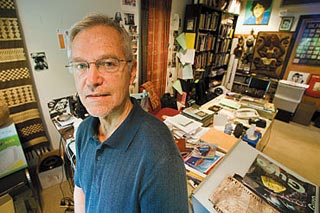
Born and raised in New York City and Hempstead, NY, Henry Drewal received his BA from Hamilton College, majoring in French and minoring in Fine Arts.
“To forget how to dig the earth and to tend the soil is to forget ourselves.”
– This best describes the story of the young Henry Drewal at 25 years, a teacher and sports master in African Church Grammar School, Abeokuta, between 1964 and 1966, living amidst the rhythm of Agbole Longe at Itoko, and with his youth partisanship at Ibara and Ake proved the inverse of this wisdom.
He did not just tend the soil, but rooted his intellectual life in its environment. That initial immersion revealed that the school where he taught and the community compound where he lived were his two great classrooms. Neither kept him small—it was the very foundation that allowed him to see the whole world. For the truly global scholar, the local environment is never a barrier, but the essential, fertile ground from which all profound human endeavor springs. This is where his future began.
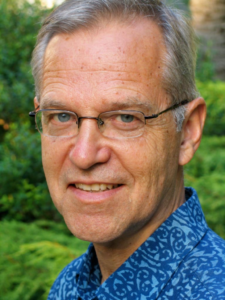
Professor Henry John Drewal. Ph.D. Columbia University, N.Y.
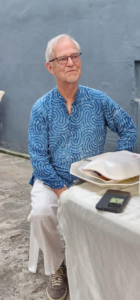
Afronews crew met with Henry Drewal, a former French teacher of our Alma mater at Lagos Branch 2025 End Of Year Party, which took place at Ikeja on Sunday, 7th Dec 2025, and having watched his dancing steps, which depict that he has journeyed across the Yoruba states and neighbouring French-speaking countries.
The team also listened to his speeches, naturally punctuated with Yoruba ancient and commanding tone. A deep look at the sun and its face did not allow us to see its shadow, and therefore, we decided to interview him. At 6.23 pm, the AfroNews crew got him seated, and the joy of life comes from our encounter with experiences that offered a new sun.
Henry Drewal – The Afrograms Teacher: 1964 – 1966.
Between September 1964 and August 1966, the young Henry Drewal was not yet the globally recognized scholar; he was simply the dedicated teacher at African Church Grammar School (Afrograms), Abeokuta. He immersed himself in the challenging dual role of French and English Teacher and the school’s sports coach. His energy was boundless, his impact immediate, but the experience was far more than a simple teaching assignment.
He did not live in an impersonal expatriate compound. Instead, he made his home in the very heart of the community, residing at Agbole Longe at Itoko. This decision, an act of genuine cultural immersion, proved to be a foundational element of his future academic direction. It was here, amidst the rhythms and routines of a traditional Yoruba compound, that he began to see the world not as an outsider, but as a temporary resident.
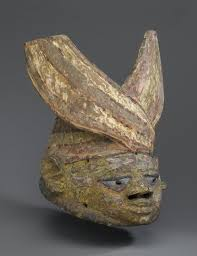
The cultural apprenticeship of those two years was deep. His youth training, specifically his involvement in sculptor designs at both Ibara and Ake, still echoes vividly in his mind. These early, tactile experiences with local artisans and materials were the first seeds of his later career in art history and African studies. They were lessons learned through the hands, not just from books.
The Unexpected Connection: Abeokuta and Columbia
In 1966, the chapter at Afrograms closed, but the education was just beginning. Henry Drewal returned to the United States to pursue further studies, enrolled at the University of Columbia to study African History. What most people wouldn’t realize is the surprising connection between his teaching stint in Abeokuta and his later academic career.
The two years spent teaching French, English, and coaching sports provided him with an unparalleled linguistic and cultural foundation. He did not just study Africa later; he had lived within its core, allowing him to approach his scholarly work with an authentic, empathetic depth that few others could match. Afrograms was his uncredited undergraduate degree in African life.
A Deep Dive into Yoruba Culture
Drewal’s later involvement in African studies naturally exposed him to the powerful and complex world of Gẹ̀lẹ̀dẹ́. This traditional setting, a masked performance honoring women and mothers, became a focal point of his research. Gẹ̀lẹ̀dẹ́ was not just an art form for him; it was a societal blueprint—a rich nexus of performance, ritual, and spiritual belief. He visited in 1973 and 2019 on research work to Nigeria
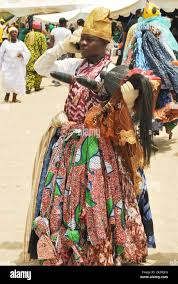
His academic quest was never confined to library stacks. It led him to travel round the major Yoruba ancient towns—visiting historical sites and understanding the political and spiritual geography of the culture he studied. He traced the roots of Yoruba tradition beyond Nigeria’s borders, visiting the old traditional homes of the Yorubas in the Republic of Benin, and followed the historical threads right down to the Ijebu ancient towns.
Identity and Memory
His deep connection to the culture is physically manifested: he wears traditional hand beads, a subtle, yet powerful, symbol of his enduring respect and participation in the Yoruba way of life. Furthermore, his relatively light complexion seems to have a unique reflection on the way he moves—a striking feature that has perhaps made his movements and participation in ceremonial music and dance even more memorable.
Now, as he revisits Afrograms, his age, full of memories of his past, is palpable. This reunion is not just a nostalgic visit; it is a pilgrimage. Every building, every scent, every whisper of the wind seems to depict a profound love memory of where he had passed through, shaping the global scholar he ultimately became. His return serves as a powerful testament to the transformative power of those foundational two years.
A Legacy of Connection
When asked how he would like to be remembered, Prof. Henry Drewal offered a profoundly simple, yet resonant answer: “I would like to be remembered not as the one who studied Africa, but as the one who connected with it. As a bridge—someone who shared his profound knowledge with humility in a simple classroom in Abeokuta is just as vital as any theory taught in a Western university.”
His legacy is not solely his publications; it is the living proof that a brief teaching stint can catalyze a life’s work, turning a classroom into a springboard for global scholarship and a temporary residence into a permanent spiritual home. “ I enjoy sharing my work on African and African diaspora arts with broad and diverse audiences. Since 1970, I have given many public lectures on a wide range of topics in both academic and non-academic settings”.
He was christened OMOBOWALE at the Lagos branch end-of-the-year party, which he gladly accepted and told us about his other name, “ISHOLA” given to him cause of his dancing tricks.
It was a party to remember, and there he vowed to visit Abeokuta, the school that reconnected him, the school he believed laid the foundation of what he is today.
As the party curtain was drawn to a close every everyone will remember him for the warmth and openness of mind he extended.
The moment Henry’s foot finds AFROGRAMS’ earth and stone, AFRONEWS shall break the news and make it known.
Compiled by: Messrs Badmus & Egberongbe

